The Sociological Imagination in a Digital World: Why Trends Happen and What Businesses Can Learn
Nathaniel Kober · · 10 min read
Part of our Business Growth & Consulting work.
Every trend, purchase and post is a personal choice shaped by forces much bigger than the person making it. That's the sociological imagination, and in a world run by algorithms and AI, it may be the most useful tool a business owner has.

Article
We wake up to news an algorithm picked for us. We ask AI assistants for recommendations. We scroll through bite-sized worldviews on our phones before we've had coffee. Every one of those moments feels personal, like our own choice. But each is shaped by forces much larger than any one person.
Sociologists have had a name for that insight for more than 60 years: the sociological imagination.
The short answer: the sociological imagination is the habit of connecting personal experiences to the larger social forces that shape them, such as history, culture, the economy and technology. In a digital world, those forces now include recommendation algorithms and AI systems that decide what we see. For business owners, marketers and creatives, it's a practical tool: understand why people think and act the way they do, and you can communicate with them more honestly and more effectively.
| Moment | What happened | What it shows |
|---|---|---|
| Ice Bucket Challenge (2014) | Millions of people filmed themselves pouring ice water over their heads and challenged friends to do the same, raising millions for ALS research. | A simple, repeatable ritual can turn private actions into a collective movement. |
| Duolingo's "Duo is dead" campaign (2025) | The language app announced its owl mascot had died. Fans mourned, celebrities joined in, and users earned more than 50 billion XP to bring him back. | Audiences don't just watch brand stories now. They take part in them. |
| Meta's AI Mode on Facebook (2026) | Facebook began answering questions with AI-written summaries of public posts, including posts in Groups. | AI now sits between people and each other's conversations, shaping what counts as "the answer." |
What is the sociological imagination?
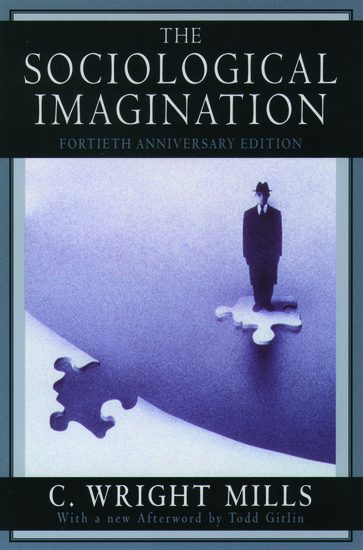
The American sociologist C. Wright Mills introduced the term in his 1959 book, The Sociological Imagination. His core distinction is between personal troubles and public issues.
Mills used unemployment as his example. If one person in a city is out of work, that's a personal trouble, and we might look at their skills or choices. But if millions are out of work, that's a public issue. No amount of individual effort explains it. You have to look at the economy, technology, policy and history.
The sociological imagination is the ability to see both at once: the individual life and the larger pattern it's part of. It doesn't excuse personal choices or erase them. It puts them in context.
How the internet changed collective thought
For most of history, what people believed was shaped mainly by where they lived: their family, their neighborhood, their school, the local paper. The internet collapsed those boundaries.
Today you can watch a protest on another continent from your couch, take a class from a university you'll never visit, and argue with a stranger in another country before lunch. Those aren't just new conveniences. They're new experiences that reshape what people believe is normal, possible or true.
Culture now moves through participation. People don't just consume content. They copy it, remix it and pass it on, from viral dances to memes to entire communities built around a single YouTube channel or Discord server. A trend that starts with a few people can reach millions in days, and it carries ideas, habits and buying decisions along with it.
When the algorithm becomes part of the picture
Here's the twist: the internet connected us, and then it started curating us.
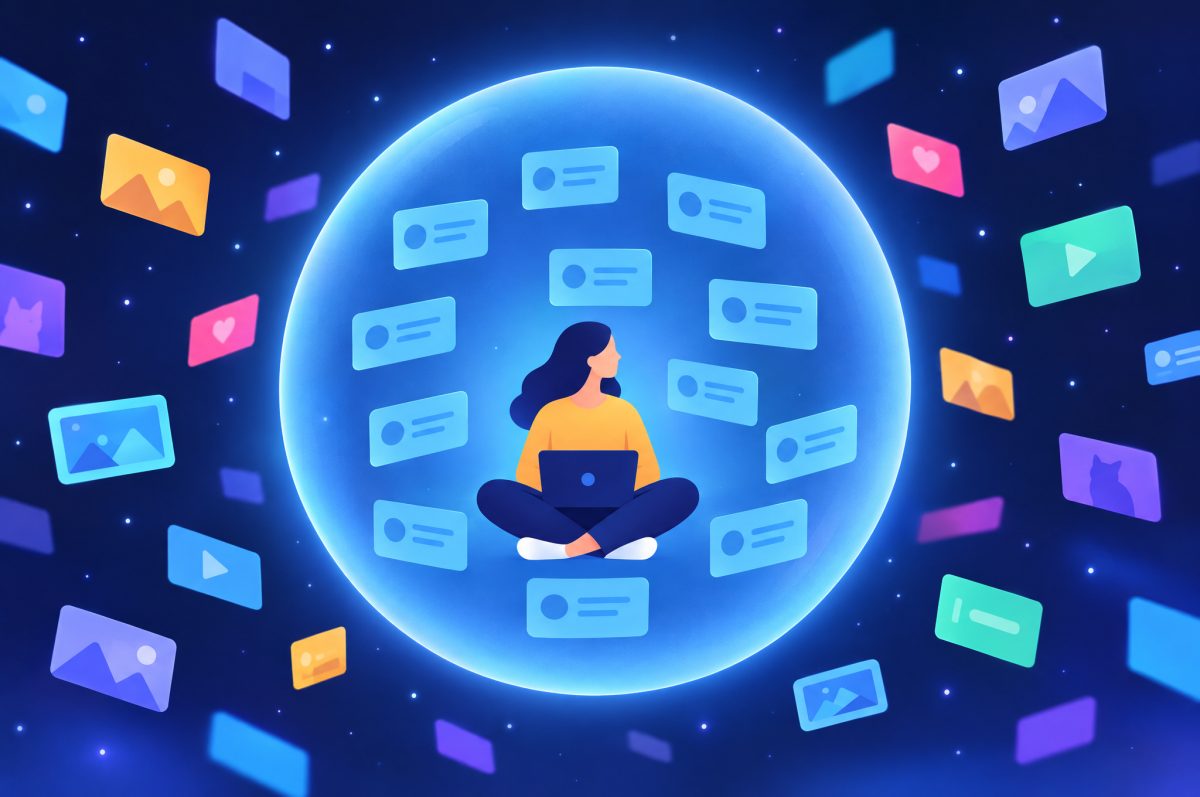
Platforms like TikTok, YouTube, Instagram and Facebook use recommendation algorithms built to keep people engaged. They don't just show you what you like. They show you more of it. The writer Eli Pariser popularized a name for the result in 2011: the filter bubble, a personalized information environment where people see more of what they already agree with and less of everything else.
Those feeds are now a primary news source for many Americans. According to Pew Research Center, about one in five U.S. adults regularly got news on TikTok in 2025, up from 3% in 2020. Among adults under 30, it was 43%.
AI is adding a new layer. In June 2026, Meta began rolling out an AI Mode for searching Facebook, which answers questions with a single AI-written summary drawn from public posts, including posts in Facebook Groups. Instead of reading what neighbors and group members actually said, a person may now read an AI's summary of it. TechCrunch noted the obvious risk: summaries built from everyday users' posts can pass along outdated or misleading information.
That changes what the sociological imagination has to cover. It's no longer only about understanding people. It's also about understanding the systems that shape how people understand each other. Generative AI is trained on enormous amounts of human writing, so it can carry society's assumptions and blind spots along with its knowledge.
The double-edged sword of online influence
The internet has turned almost everyone into a potential broadcaster, and that cuts both ways.
On one side, online communities lift up voices that used to go unheard, organize volunteers in hours, teach complicated skills for free and raise money during disasters. A single well-timed post can launch a movement or a small business.
On the other side, misinformation spreads as fast as truth, pile-ons can wreck reputations overnight, and polarization deepens when people only see their side. The same tools that connect people can divide them.
For business owners, that creates a real challenge: how do you stand out without selling out? How do you build trust with an audience that is both overexposed and skeptical?
What Duolingo's "dead" owl teaches about digital influence
On February 11, 2025, Duolingo announced that Duo, its famously pushy green owl mascot, had died. What followed was one of the most talked-about brand campaigns of the year.
- Fans posted tributes and memes, and the hashtag #ripduo was used more than 45,000 times, according to the media-monitoring firm Meltwater.
- Singer Dua Lipa, a long-running target of Duo's online "obsession," posted condolences on X. Her repost alone drew about 667,000 engagements.
- Average daily mentions of Duolingo jumped from about 11,000 before the announcement to nearly 60,000 after it.
- Duolingo then told users they could bring Duo back by completing lessons. Together, they earned more than 50 billion XP, the app's experience points, and Duo returned on February 24, according to NPR.
Our own count: about 1.7 billion impressions
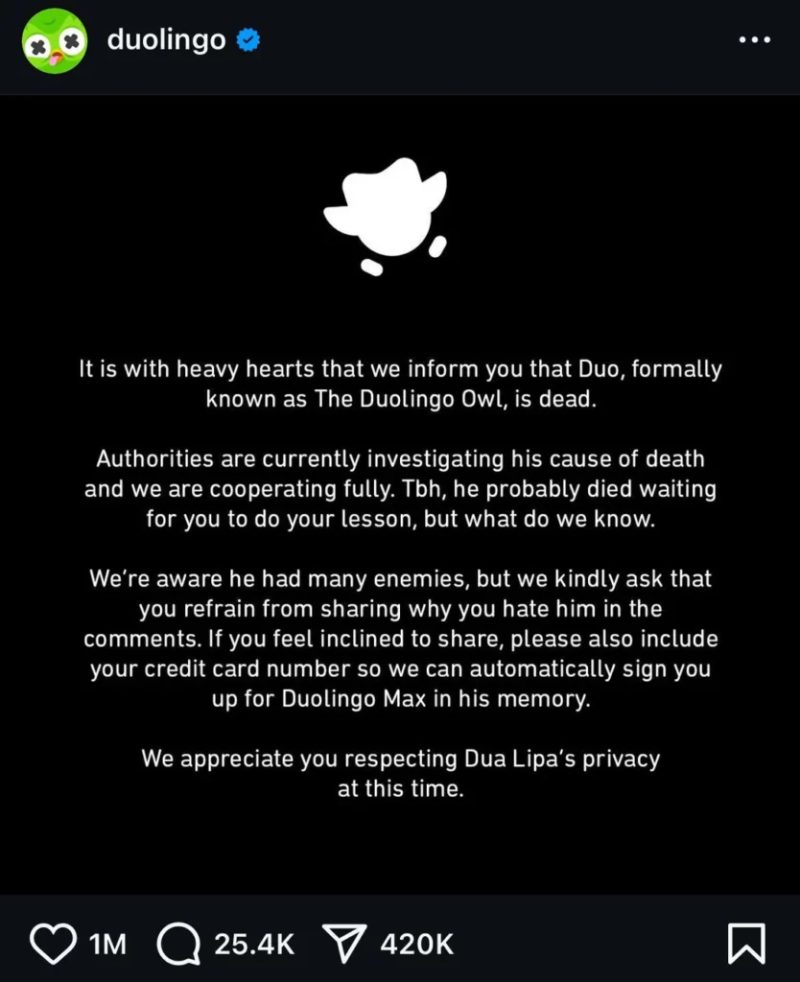
When we first wrote about this campaign for The KOS Review in April 2025, we went through Duolingo's campaign posts and their public analytics ourselves. By our count, the campaign generated roughly 1.7 billion social impressions. The TikTok video announcing Duo's death alone had about 557,500 likes, 20,300 comments and 38,700 saves at the time, and the Instagram announcement shown here has about 1 million likes, 25,400 comments and 420,000 shares.
That figure is our own tally from a point-in-time review, not an official Duolingo number. But it lines up with the independent data: a hashtag used more than 45,000 times, daily mentions up more than fivefold, and a single celebrity repost reaching hundreds of thousands of people. For a language-learning app, that's a massive brand-awareness boost, and it grew even larger as other well-known brands joined in.
The original post is still on Duolingo's Instagram. Notice how it's written: a mock obituary, an inside joke about Dua Lipa and a jab at users who skipped their lessons. It reads like a friend's post, not an ad.
Seen through the sociological imagination, this wasn't just clever marketing. Duolingo tapped into something people already do together online: mourn, joke, react and rally around shared symbols. The campaign worked because it invited participation, turned a cartoon owl into a shared ritual, and gave people a reason to use the actual product.
Not every business should fake a mascot's death. But the lesson travels: people don't follow products so much as people, values and stories. Your brand is how people feel about you within their own cultural world.

Why business owners and creatives need sociological awareness
If you've ever wondered why one post took off and another went nowhere, you've already started thinking sociologically. The sociological imagination turns that curiosity into a habit. It helps answer questions like:
- Why is my audience skeptical of authority, or of advertising?
- Which symbols and references mean something to my customers, and which ones fall flat?
- How do privacy worries affect whether people trust my website or my app?
- Why do some campaigns spread while others disappear?
Answering those questions helps you build products that fit people's real lives, market with empathy instead of manipulation, and lead with foresight instead of just reacting.
For creatives such as photographers, designers and writers, it unlocks better stories. It shapes what you frame, whose voices you include, and what you leave out. Behind every face in a photo is a life shaped by forces bigger than that person.
Other articles in this series apply specific sociological lenses to everyday business questions. Why a 4.7 beats a 5.0 uses symbolic interactionism to explain how customers read star ratings. Who gets seen online? uses conflict theory to explain why visibility favors the big players, and where local businesses still win.
Putting the sociological imagination to work
Four habits make this mindset practical:
- Zoom out. Before making a decision, ask what larger forces might be shaping the situation: the economy, technology, culture, the season, the news cycle.
- Ask "why" five times. When your audience responds to something, keep asking why. Why this format? Why now? What does it say about their lives right now?
- Look beyond your own bubble. Your feed isn't the world. Talk to customers who aren't like you, and read sources you wouldn't normally see.
- Audit your content. Are you reinforcing stereotypes or challenging them? Are you including the full range of people you serve, or only the most familiar ones?
What that can look like in practice:
- A local service business notices more evening inquiries and realizes more customers now work hybrid schedules, so it adds online booking after hours.
- A photographer builds a campaign around three generations of a family business, telling a story about the town as much as the shop.
- A brand designer tests whether a color palette reads the same way to every audience it needs to reach.
In each case, the sociological imagination isn't academic. It's strategy.
In a world of algorithms, be human
As AI, automation and algorithms shape more of daily life, human insight becomes more valuable, not less. The sociological imagination is a compass. It reminds you that every post, trend and tech shift is part of a bigger story, one that links personal choices to the world around them.
So whether you're launching a business, building a brand or telling a story, don't just ask what works. Ask why it works, and for whom.
Our branding and creative design and digital marketing teams start every project with exactly those questions.
Frequently asked questions
What is the sociological imagination?
It's the ability to connect individual experiences to larger social forces such as history, culture, the economy and technology. The sociologist C. Wright Mills introduced the term in his 1959 book The Sociological Imagination.
What is an example of the sociological imagination?
Mills's classic example is unemployment. One person losing a job is a personal trouble. Millions losing jobs is a public issue explained by the economy and technology, not individual effort. Online, a viral trend is a similar case: each person chooses to join, but algorithms, culture and timing explain why millions do at once.
What is a filter bubble?
A filter bubble is a personalized online environment where algorithms show people more of what they already engage with and agree with, and less of everything else. The writer Eli Pariser popularized the term in 2011.
How does social media influence behavior?
Social media shapes what people see, what seems normal and what spreads. Recommendation algorithms amplify content that gets engagement, and people copy and remix what they see. About one in five U.S. adults now regularly gets news on TikTok, according to Pew Research Center.
Why should businesses care about sociology?
Because customers' choices are shaped by forces beyond the product itself: culture, trust, technology and the people around them. Understanding those forces helps businesses communicate honestly, design better products and anticipate change.
More from this series
This article is part of a Deep Sky series on the sociology of the internet:
- Website accessibility and the ADA in 2026: who has to comply, and by when.
- Who regulates your website? The FTC, the states and the rest of the rulebook for 2026.
- The digital divide in 2026: who's still left out, and why local websites must work for them.
- Designing websites for older adults: they're online, so build for them.
- Why a 4.7 beats a 5.0: the sociology of online reviews.
- Who gets seen online? Algorithms, paid reach and how local businesses still win.
Sources
- C. Wright Mills, The Sociological Imagination (Oxford University Press, 1959)
- Pew Research Center, 1 in 5 Americans now regularly get news on TikTok, up sharply from 2020 (September 25, 2025)
- TechCrunch, Meta's new AI Mode on Facebook pulls from public info across its platforms (June 15, 2026)
- Duolingo on Instagram, "Duo is dead" announcement (February 2025)
- Kosmic Edge (then Kober Online Solutions), review of Duolingo's public campaign post analytics, April 2025
- Meltwater, Duolingo's Dead Mascot Campaign (2025)
- WGCU / NPR, Duolingo's owl mascot is alive after all. What did it gain from faking his death? (February 26, 2025)
This article was first published on The KOS Review in April 2025 and was rewritten and updated for Deep Sky in October 2026.