Choosing a Web Agency: 10 Questions to Ask Before You Sign (Including Ones That Might Rule Us Out)
Nathaniel Kober · · 9 min read
Part of our Business Growth & Consulting work.
Most website quotes look alike until something goes wrong. These ten questions separate the agencies that will still be answering your calls in year three from the ones that won't, and two of them are questions where the honest answer might send you somewhere other than us.

Article
Three website proposals land on your desk. They all promise a modern, mobile-friendly site that's good for search. The prices are different, the portfolios all look nice, and every one of them says "custom." How do you choose?
Most owners pick on price or on whoever they liked best in the meeting. Both are reasonable, and both miss the things that cause trouble later: who controls the domain, what happens after launch, and who actually does the work.
The short answer: ask every agency the same ten questions, and pay as much attention to how they answer as to what they say. A good agency answers plainly, puts the important parts in writing, and will tell you when they're not the right fit. The questions below cover ownership, cost, people, process and what happens after launch, and a few of them might rule us out. That's the point.
The ten questions
1. Can I see sites you've built that are live right now, and talk to those clients?
A portfolio shows what a site looked like on launch day. A live site shows what it looks like today. Open three or four on your phone. Do they load quickly? Is the information current? Do the contact forms work?
Then ask for two references you can call, ideally clients who have been with the agency for more than a year. Ask them one question: "What happens when something goes wrong?"
Listen for: live links and names offered without hesitation.
2. Who will actually do the work?
Some agencies do everything in-house. Many use freelancers or overseas partners for parts of the job. Either can work well. What matters is knowing who is building your site, who your day-to-day contact is, and whether the person who sold you the project will still be involved after the contract is signed.
Listen for: a named contact and a clear answer about who designs, who builds and who writes.
3. Whose name will the domain and hosting be in, and what happens if I leave?
This is the most important question on the list. It's common, and perfectly reasonable, for an agency to register your domain and host your site as part of a service. Many clients prefer it. What matters is that you can always get them back.
Under ICANN's rules, the registered holder of a domain controls its transfer to another registrar, and the current registrar has to provide the transfer code within five calendar days of a request. If the agency is the registered holder, you need its cooperation. So get the exit terms in writing before you sign: if you leave, you receive your domain, a full copy of your site and your content, with nothing standing in the way except any unpaid balance.
Listen for: "Yes, it's yours, here's how a transfer works."
Red flag: vague answers, or exit fees for "releasing" a domain you've paid for.

4. What exactly is in the price, and what costs extra?
Two quotes for "a five-page website" can describe very different jobs. Ask for a written list of what's included:
- the number of pages and design options
- how many rounds of changes
- who writes the words and who supplies the photos
- forms, booking tools, maps and other features
- basic search setup, such as page titles and your Google Business Profile
- training, so you can make simple edits yourself
Then ask what usually ends up costing extra. An honest agency will tell you, because the answer is almost always the same: extra pages, extra rounds of changes and content that arrives late.
5. What happens after launch?
A website isn't finished when it goes live. Software needs updates, backups need checking and things break. Ask whether the agency offers ongoing care, what it covers, what it costs per month and what they charge per hour for anything outside it.
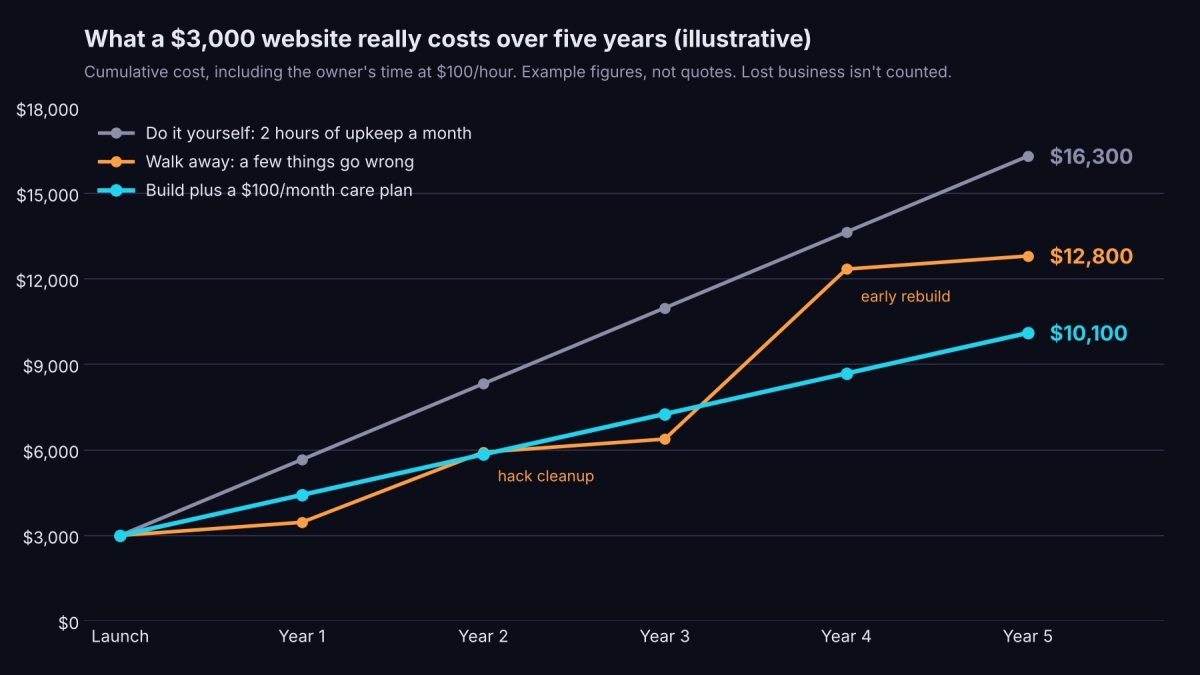
If the answer is "nothing, you're on your own," that's fine for some sites. Just budget for it, using our five-year cost comparison and our guide to what managed WordPress care actually covers.
6. What will you build it on, and could someone else work on it later?
Most small business sites are built on WordPress or a hosted builder like Squarespace, Wix or Shopify. A few agencies use their own custom systems. Custom isn't automatically bad, but it can mean that only that agency can ever work on your site.
Listen for: a platform other developers know, and a clear reason it fits your business.
7. How do you handle accessibility?
WebAIM's 2026 scan of the top one million home pages found detectable accessibility failures on 95.9% of them. For businesses open to the public, the ADA is enforced largely through private lawsuits. For local governments, there are now firm federal deadlines. We cover both in website accessibility and the ADA in 2026.
Listen for: WCAG 2.1 or 2.2 Level AA, and testing with a keyboard and a screen reader.
Red flag: a one-line widget or "overlay" offered as the whole solution.
8. What will you need from me, and when?
The most common reason website projects run late isn't the agency. It's content: the words, photos and decisions that only the client can provide. A good agency tells you up front what it will need, by when, and what happens to the schedule if it arrives late. We explain why in what a website project looks like, from kickoff to launch.
9. How will we know if the site is working?
"It looks great" isn't a goal. Ask how the agency will measure success: calls, form submissions, bookings, direction requests or visits from search. Ask whether you'll get access to your own analytics and Google Business Profile, in your own account.
Listen for: a short list of real goals tied to your business, and reporting you can read without a translator.
10. What kind of client are you not a good fit for?
This is the most revealing question you can ask. An agency that says "we're a great fit for everyone" either hasn't thought about it or won't tell you. One that names the clients it turns away, and why, is showing you how it will behave when an honest answer costs it money.
Green flags and red flags at a glance
Green flags
- Live sites and real references, offered freely.
- A written scope that lists what's included and what isn't.
- Clear exit terms: your domain, files and content come with you.
- A named contact who will be there after launch.
- Plain answers about price, including ongoing costs.
- They ask about your business before they talk about design.
- They tell you when something isn't worth paying for.
Red flags
- "We'll handle the domain" with no written exit terms.
- Guaranteed first-page Google rankings. Nobody can promise that.
- A price that's far below every other quote, with no clear reason.
- Pressure to sign this week.
- A custom system only they can edit.
- No answer to "what happens after launch?"
- An accessibility widget presented as compliance.
When you might not need an agency at all
An agency isn't the right answer for everyone, and it's worth saying so plainly.
- You want to build and run the site yourself. Hosted builders like Squarespace, Wix and Shopify are genuinely good, handle their own software updates, and cost far less than a custom build. If you have the time and want the control, start there.
- Your site is a simple online business card. If nobody finds you through your website and it brings in no calls, a well-kept Google Business Profile may do more for you than a new site.
- You need one small thing. A single new page or a fix to your contact form is a job for a freelancer or a few hours of an agency's time, not a full project.
Where we'd rule ourselves out
We asked ourselves the tenth question, too. We're probably not the right fit if:
- You want the cheapest possible build and no one looking after it afterward. Our work is built around long-term care, and we'd rather tell you that up front than sell you something you'll resent.
- You want to manage everything yourself on a hosted builder. You may not need us, and we'll happily say so.
If you're somewhere in between, a local business, nonprofit or municipality that wants a site that works and someone to keep it working, that's who we build for. Our answers to the other nine questions: you can see our work live, you'll know who's doing it, our plans are built so we never hold a site hostage except over an unpaid balance, and we'll put all of it in writing.
Frequently asked questions
What should I ask a web designer before hiring them?
Ask to see live sites and talk to past clients, who will do the work, who will hold your domain and hosting and what happens if you leave, what's included in the price, what happens after launch, what platform they use, how they handle accessibility, what they need from you, how success will be measured, and who they're not a good fit for.
Should my web designer own my domain name?
It's common for an agency to register and manage your domain as part of a service. What matters is a written agreement that the domain is yours and will be transferred to you on request, with nothing standing in the way except any unpaid balance.
Can a web agency guarantee first-page Google rankings?
No. No one controls Google's rankings, and Google itself warns against companies that guarantee them. A good agency can explain what it will do to improve your visibility and how it will measure results.
Do I need an agency, or can I build my own website?
If you have the time and want full control, hosted builders like Squarespace, Wix and Shopify work well for many small businesses. An agency makes more sense when the site needs to bring in business and you'd rather spend your time running it.
Related reading
- One-time build vs. ongoing care: what a website really costs over five years.
- What a website project looks like, from kickoff to launch.
- How to review a website design draft, without saying "make it pop."
- What managed WordPress care actually covers, and why sites break without it.
- Website accessibility and the ADA in 2026.
Sources
- ICANN, 5 Things Every Domain Name Registrant Should Know About ICANN's Transfer Policy
- ICANN, Registrants' Benefits and Responsibilities
- WebAIM, The WebAIM Million: 2026 report
- Google Search Central, Do you need an SEO?
The illustrations in this article are AI-generated.